
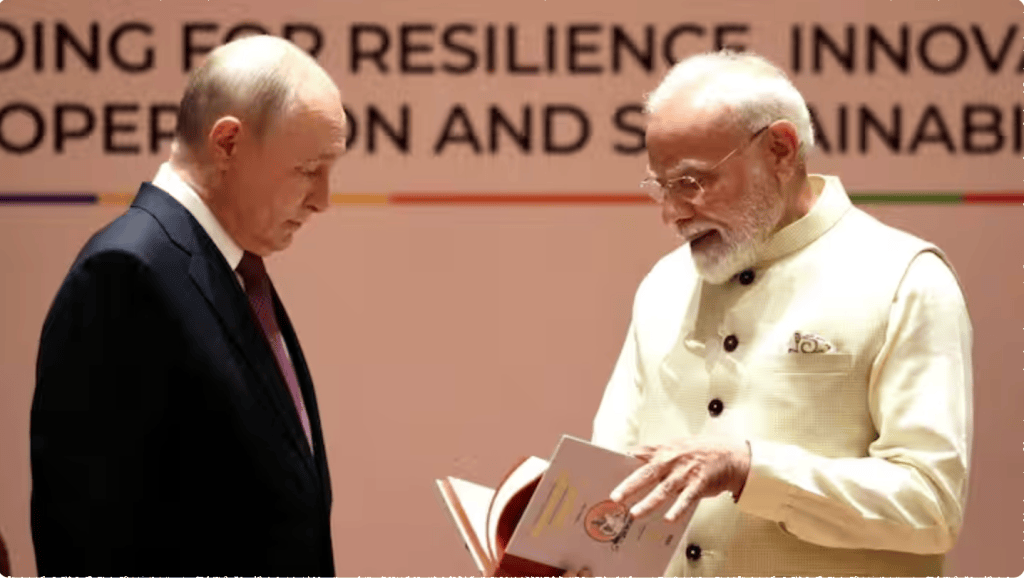
Among the gifts presented during the BRICS Summit in New Delhi was a Russian translation of the Thirukkural, given by Prime Minister Narendra Modi to President Vladimir Putin.
The Thirukkural, traditionally attributed to Thiruvalluvar, contains 1,330 couplets arranged in 133 chapters and divided into three books, aram, porul and inbam. These are usually rendered as virtue, wealth or polity, and love, though such translations flatten somewhat the range of the original. Porul, which occupies more than half the work, deals with kings, ministers, taxation, justice, diplomacy, war, agriculture, education and the conduct of public life. The familiar description of the Kural as a book of ethics is therefore correct only in the broadest sense, for its ethics are tied closely to government and social order.
This is one reason the work sits awkwardly within the usual treatment of ancient Indian thought outside India. Indian texts are still often introduced through religion, metaphysics or spirituality, categories into which the Thirukkural only partly fits. Valluvar was interested in virtue, certainly, but also in rulers, counsel, poverty, friendship, desire and the practical business of living among other people.
The Kural travelled early. A Latin translation appeared in 1730, and French, German, English, Russian and other versions followed. By 2026 it had been translated into 57 languages in hundreds of separate editions. Tolstoy knew it; Gandhi wished to learn Tamil in order to read it in the original; Albert Schweitzer praised it; and the Russian philosopher Alexander Piatigorsky placed it among the works of world literature.
Yet, for all this circulation, the Thirukkural has remained curiously provincialised in the modern literary imagination. Dante has never ceased to be Italian, nor Goethe German, nor Tolstoy Russian, yet each passed comfortably into the category of world literature. The Thirukkural, by contrast, is still usually encountered abroad as a major work of Tamil literature, an accurate description that has often served as a terminus rather than a beginning.
The Russian volume presented in New Delhi therefore belongs to a much older history than the summit itself. The Thirukkural had already crossed languages and intellectual traditions long before BRICS existed. Its appearance there offered a timely reminder that it deserves mention among the major works of world literature, rather than being confined to the narrower category of Tamil literary history.
 The Whole Past
Leave a comment